
Europe at a Crossroads - It's 5 Minutes to Midnight
TOTW
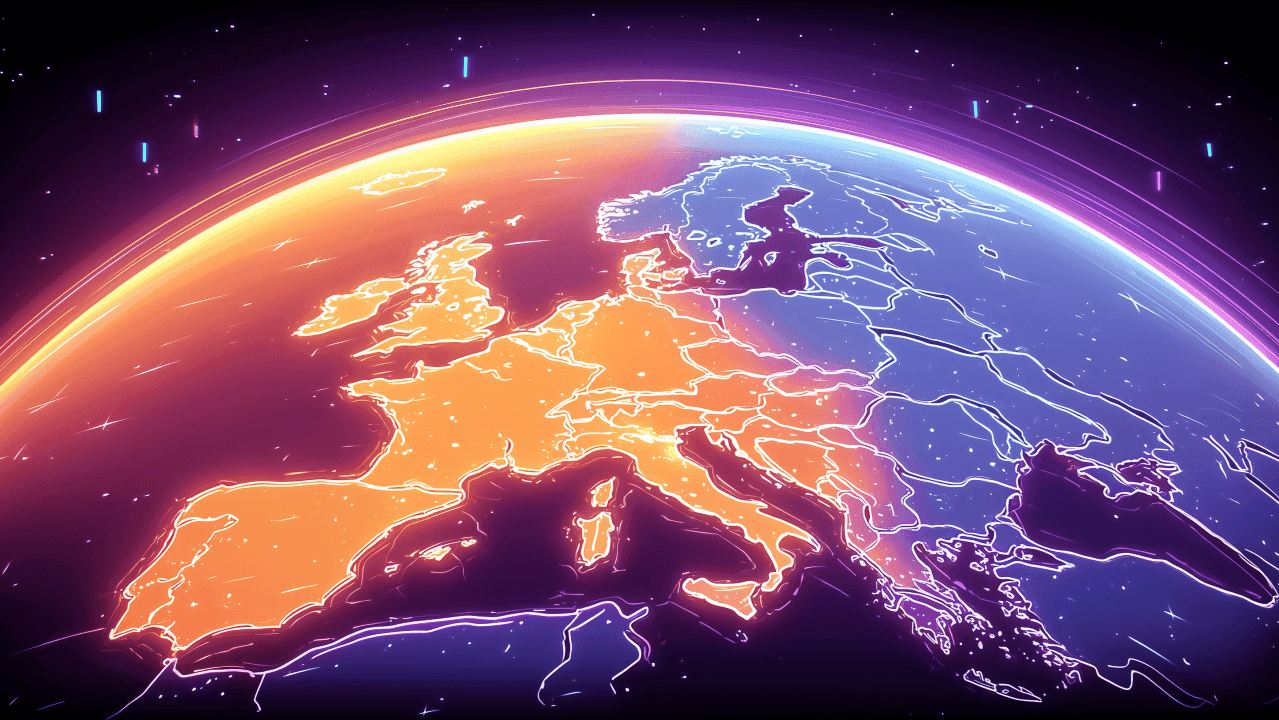
Last week I wrote about my visit to Björn Soenens' powerful performance "Allemaal Amerikaans" and the confrontation with the American Nightmare - the reality behind the American Dream for most people. It made me think: this is where pure market forces lead without a social contract. Europe consciously built a different model. A welfare state where human dignity is central, not just profit maximization.
But that model is under pressure. And the question we must ask ourselves is not "are we becoming America?", but: "What will Europe become?"
All Signals Are Red
We find ourselves at a historic turning point. And it's no coincidence that this happens exactly 80 years after the end of World War II. Ray Dalio describes in his work on long economic cycles how societies go through a fundamental crisis and reset approximately every 80 years.
Look at the signals around us:
Debt burden: Belgium has a budget deficit of 4% of GDP. We're in a stalemate - don't touch indexation, don't touch VAT - while the debt burden suffocates us.
War on European soil: For the first time since 1945, tanks are rolling through Europe again. Ukraine seems like a proxy war, but for what? Globally, conflicts are more numerous than I've ever seen in my lifetime. Some say WWIII has already begun - through proxies, trade wars, cyber wars.
New world order: China has emerged as a rival to the US. Europe is becoming the playing field between two superpowers. The US, once our reliable ally, is withdrawing or playing its own game. International institutions like the UN and WHO are under pressure.
Extremism and fragmentation: From Belgium to Poland, from France to the Netherlands - everywhere we see the rise of extremism, both left and right. Europe divides instead of unites. Brexit was a harbinger.
These are the classic symptoms of the end of an 80-year cycle.
But there's something new. Something our ancestors in the 1940s didn't have:
The Technological Acceleration
We stand on the eve of the greatest technological transformation since the Industrial Revolution. And I'm not talking about science fiction. I'm talking about today.
AI is changing the labor market now:
SAP announced it would hire fewer developers - AI compensates for their productivity needs
Companies have become structurally more cautious about hiring juniors
The productivity gains are real and measurable
Klarna automates 66% of help desk activities - beginning of 2024. I don't know what the current status is.
And we don't need to wait for AGI (Artificial General Intelligence). With the technology we have today, an estimated 60% of tasks in our economy can be automated. Add advanced robotics in 5-10 years, and we approach virtually all physical labor.
This is not something for 20 years from now. This is starting now. The full impact will unfold over the next 10-15 years.
But AI is not alone. Think about biotechnology, quantum computing, advanced robotics. These technologies reinforce each other and create exponential change - what I've previously described as the Flywheel of Continuous Accelerated Progress (TOTW 13): AI helps us discover new materials, which enables better hardware, which creates more powerful AI, and so on.
And all these crises - debt, war, polarization, technological disruption - they reinforce each other. That's why it feels so intense.
The Paradox: We Applaud What Weakens Us
In my latest post, I showed we applauded mega-investments:
Amazon invests 1 billion in Belgium
Google invests 5 billion in data centers
More jobs, better services, strengthened competitive position. Good news, right?
But here's the paradox:
Amazon competes with European players like bol.com. Google's data center expansion makes it harder for European alternatives like Mistral AI or Scaleway. We welcome investments that increase our technological dependence, while we need sovereignty.
And then I look at China.
China works with five-year plans that seamlessly connect to thirty-year strategies. They think in decades, not election cycles. Their 13th plan focused on poverty reduction - they achieved that goal. Their 14th plan focuses on high-quality productive forces - they're becoming world leaders in strategic sectors.
As Xi Jinping put it: "Plans must be based on facts, scientifically sound, and well-received by the people."
And us? We think in periods of 4-5 years. Until the next election. We solve yesterday's problems while tomorrow is already knocking on the door.
The deeper problem: Europe has no digital champions of its own. Not just an American problem (Amazon, Google, Meta, Microsoft). Also a Chinese problem (Alibaba, ByteDance, Tencent - less visible in Europe but equally dominant). Europe remains the playing field between these two.
But it doesn't have to be this way. Europe has proven we can do this:
ASML - Dutch world leader in chip machines, indispensable for the entire semiconductor industry
SAP - European software giant
Spotify - Swedish platform that transformed the music industry
ARM - British chip architecture in almost every smartphone
CERN - Where the World Wide Web was invented
IMEC - outstanding chips designer
We can do it. If we want to. If we dare to invest in our own future.
The Fundamental Question: From Labor Shortage to Job Shortage
Here comes the most difficult conversation. The conversation politicians prefer to avoid. Today we talk about a shortage of workers. Companies struggle to find personnel. Aging puts pressure on the labor market. But within 10 to 15 years this may shift to a shortage of traditional jobs.
Why? Because productivity is exploding through AI. One employee with the right tools can do the work of five or ten employees from ten years ago.
That's fantastic for prosperity and growth. But it undermines the foundation of our economic model:
Work = income = taxes = welfare state
If labor is no longer the primary source of value creation, but capital (data, algorithms, AI systems), then this entire system collapses.
The question we dare not ask:
How do we organize a society where full employment is no longer the goal?
What becomes the new basis for income distribution?
How does our social model survive if the tax base (labor) shifts to capital?
How do we prevent all profits from being concentrated with a small elite that owns the AI?
This is not science fiction. This is 2040.
And if we don't think about this, we're solving yesterday's problem (shortage of workers) while tomorrow's problem (shortage of work) is already forming.
Questions to Our Politicians
I understand the unrest. I understand last week's strike in Brussels. Change is scary. But we shouldn't be angry at those who are now trying to keep our ship upright. We should be angry at previous governments that failed to reform in time.
And at the same time, we need more than just solving today's problems.
We need a vision for 2040. A strategic framework that looks beyond election cycles. A compass for now and for future governments. Voka Oost-Vlaanderen 's HITT may well be the kind of excercise we need for Flanders, Belgium and Europe.
Therefore, I want to ask several questions:
1. Economic Sovereignty and Technology
Do we want European tech champions? Or do we remain a playing field?
What incentives are we willing to give to our own enterprises?
How do we create an investment climate where startups don't leave for the US?
Concrete: I hear voices about a wealth tax. But is that smart? If we want wealthy people to invest in Europe's future, in our startups, in innovation - why would we chase them away? Let's stimulate them to be part of the solution.
2. Regulation: Retain, Simplify, Remove
Which regulations serve our long-term vision (sovereignty, sustainability, ethics)? Retain and strengthen them.
Which regulations inhibit innovation without added value? Remove.
Proposal: Let's introduce a "recycle bin" for legislation. Structurally clean up what's outdated. Because we keep adding new rules, but we remove too little. The whole becomes unworkable. Recycling simplifies.
3. Defense and Technological Defense
We've learned we must be able to provide for our own security. For decades we slept under the American umbrella. We no longer have that luxury.
But: Technology is as important a battlefield as tanks and aircraft.
How do we build European digital defense?
How do we protect our critical infrastructure?
How do we prevent remaining dependent on foreign cloud providers for our most sensitive data?
4. The New Social Contract
This is the most difficult question, and the most urgent:
How do we prepare for an economy where work no longer equals income?
What is our new social contract?
How do we ensure technological progress benefits everyone, not just capital owners?
What experiments do we dare to do? (Basic income? Capital participation? Work time reduction?)
5. The Most Difficult Question: Sacrifices and Solidarity
What sacrifices are we willing to make - on all sides of the spectrum?
How do we convince people of the need for long-term thinking?
How do we break through popularity-poll politics where unpopular but necessary measures seem impossible?
Why Now? It's 5 Minutes to Midnight
I have no rational explanation for the urgency I feel. But I feel it deeply.
It's 5 minutes to midnight. Maybe later.
All the signals are there:
The AI transition is happening now, not in 10 years
The geopolitical balance of power is shifting now
Europe is fragmenting now
Debt is becoming now unsustainable
The climate crisis is escalating now
But there's also an opportunity. A historic opportunity.
When two dogs fight over a bone, the third runs away with it.
Dog one: The United States - an unreliable ally abandoning its partners, divided by internal polarization, where the social contract is torn.
Dog two: BRICS with China as the dominant player - an authoritarian alternative where individual freedom is subordinate to state power.
The third way: Europe.
Not the current divided Europe. But a coalition of the willing. A Europe that dares to go its own way. With allies: Canada, progressive South America, parts of Asia, Oceania. An alliance of democracies that believe in prosperity and dignity. In free markets and social protection. In innovation and ethics.
Europe as the balance between American hypercapitalism and Chinese authoritarianism.
But only if we act now.
I Remain an Optimist
By nature, I'm an optimist. I believe in Europe's potential.
We have the knowledge. We have the resources. We have the values. We've proven we can create world leaders - ASML, SAP, Spotify, ARM, CERN.
But we lack the courage and vision.
✅ What we need:
A strategic framework for 2040 that looks beyond elections
A decision-making framework for current and future governments
Courage to challenge sacred cows
Willingness to make sacrifices for our children and grandchildren
Cooperation across ideological divides
❌ What we don't need:
All the answers (nobody has them)
A perfect blueprint (too complex)
Absolute certainty (impossible)
💡 What we do need:
A debate about what Europe we want
Dare to experiment
Learn from others: China's long-term planning, but in a European way; America's investment climate, but in a European way
Connect instead of divide
The Call
To our politicians: think beyond the next election. We elected you to make difficult choices. To secure our future, not to follow popularity polls.
To business leaders and entrepreneurs: invest in Europe's future. Not just because you can, but because you must. We need you as engines of change.
To everyone listening: it's time for a different conversation. Not about left versus right. Not about who's right. But about what kind of society we want to build for the next generation.
Share to social media